
The altimeter reads 8,000 ft. Lieutenant Robert Bob Bram squints through the perspects canopy of his Bristol bow fighter as it cuts through the darkness over the North Sea. It’s 2:47 a.m. on December 14th, 1941. His navigator, flight sergeant William Stixs Gregory, hunches over his charts in the cramped rear compartment, pencil scratching against paper as he recalculates their position for the third time in 20 minutes. Gregory’s hands are shaking.
Not from fear, but from the brutal cold seeping through the aircraft’s thin aluminum skin. The temperature outside hovers at -15° C. Inside, it’s barely warmer. His fingers, even wrapped in thick gloves, can barely grip the pencil. He’s supposed to guide them back to RAF wittering after a fruitless patrol hunting German bombers over the English Channel.
But something is wrong with his calculations. Terribly wrong. The numbers don’t match. According to his dead reckoning navigation, accounting for wind speed and direction, they should be approaching the English coast near Norfolk. But his stopwatch says they’ve been flying for 43 minutes since turning for home. At their cruising speed of 280 mph, that puts them Gregory’s stomach drops.
That puts them at least 60 mi past where they should be. He’s made a catastrophic error. Instead of calculating a westward heading to compensate for the northeasterly wind pushing them off course, he’s done the opposite. He’s added degrees when he should have subtracted them. It’s the kind of mistake that gets air crews killed.
The kind that ends with a bow fighter slamming into the cold North Sea with no one ever knowing what happened. Sticks. Where the hell are we? Bram’s voice crackles through the intercom, tension evident even through the static. We should be seeing the coast by now. Gregory opens his mouth to confess his error, to tell his pilot they’re hopelessly lost over enemy controlled waters.
But before he can speak, Bram’s voice cuts through again, sharp and urgent. Wait, lights dead ahead. Multiple lights. What neither of them knows in this moment is that Gregory’s mathematical error hasn’t doomed them. It’s about to hand British intelligence the location of one of Nazi Germany’s most secret airfields.
A discovery that will alter the course of the air war and save thousands of Allied lives. By December 1941, the Luftvafa’s nightbombing campaign against Britain has evolved into a deadly game of cat and mouse. After the devastating blitz of 1940 1941, German bomber crews have refined their tactics. They no longer attack in massive formations that British radar can easily detect.
Instead, they operate from secret forward airfields along the occupied European coast, launching small groups of aircraft on precision night raids against British cities and industrial targets. British air intelligence knows these forward bases exist. They have to. German bombers are appearing over British targets with disturbing regularity.
Yet reconnaissance flights over known Luftvafa airfields in France, Belgium, and the Netherlands show normal activity levels. The mathematics are simple and terrifying. The Germans are operating from hidden airfields that British intelligence hasn’t located. The consequences of this intelligence gap are measured in blood and rubble.
Between September and December 1941, German night raiders kill one a kah 47 British civilians and destroy countless factories, warehouses, and infrastructure. RAF fighter command throws everything at the problem. They increase night patrols. They deploy more radar stations along the coast. They send reconnaissance aircraft on dangerous daylight missions over occupied Europe, searching for the hidden bases. The results are dismal.
In 3 months of intensive searching, RAF Reconnaissance has identified only two previously unknown German airfields, both minor facilities. Meanwhile, German bombers continue their raids with impunity. The Luftvafa’s operational security is nearly perfect. They’ve learned from earlier mistakes. Their secret airfields maintain strict radio silence.
They use camouflage netting and dummy buildings to deceive aerial reconnaissance. They even rotate aircraft between bases to prevent British intelligence from tracking specific units. Air Chief Marshall Sir Schultto Douglas, commanding RAF Fighter Command, faces a strategic nightmare. His night fighters are flying blind, literally and figuratively.
Without knowing where German bombers are launching from, his aircraft waste precious fuel and time patrolling empty stretches of the North Sea and English Channel. The kill ratio tells the grim story. In November 1941, RAF Knight fighters fly 847 combat patrols. They achieve only 12 confirmed kills of German bombers.
That’s a success rate of 1.4%. For every German bomber destroyed, British night fighters burn through alul 18,000 gallons of aviation fuel and risk multiple air crews in dangerous night operations. The expert consensus within RAF intelligence is unanimous and depressing. Without better radar coverage, without more sophisticated detection equipment, without signals intelligence breakthroughs, they cannot locate the secret German airfields.
The technology simply doesn’t exist yet. Squadron leader Derek Jackson, one of the RAF’s top radar experts, writes in a classified memo dated November 28th, 1941, “The current generation of airborne radar cannot reliably detect ground installations from operationally safe altitudes.
We are in effect asking our air crews to search for needles in a haystack the size of continental Europe. The stakes extend beyond the immediate tactical problem. British codereakers at Bletchley Park are making progress breaking German military communications, but they need physical evidence to validate their intelligence if they can locate a secret German airfield and observe its operations.
They can cross reference that data with decoded German messages. This would confirm their codereaking methods are accurate and help them break additional German codes. Prime Minister Winston Churchill himself is demanding answers. In a heated war cabinet meeting on December 10th, 1941, he pounds the table and declares, “We are being struck by an invisible enemy.
This is intolerable. I want those airfields found, and I want them found now.” 4 days later, Flight Sergeant William Gregory will accidentally give Churchill exactly what he’s demanding, though not in any way the prime minister or anyone else could have anticipated. William Gregory is nobody’s idea of a hero.
At 23 years old, he’s a former grocery clerk from Nottingham who joined the RAF in 1939 because it seemed more exciting than stacking tins of beans. He barely passed his navigation training course at RAF Cranwell, graduating 47th out of 52 students. His instructors noted in his file, adequate mathematical [clears throat] skills, tends to rush calculations, requires additional supervision.
That assessment is generous. Gregory knows he’s not a natural navigator, unlike some of his classmates who seemed to instinctively understand celestial navigation and dead reckoning. He has to work twice as hard to achieve half the results. He carries a worn notebook filled with formulas and correction factors, constantly referring to it during flights because he can’t keep the calculations straight in his head.
His pilot, Lieutenant Robert Bram, is his opposite in almost every way. At 20, Bram is already an ace with seven confirmed kills. He’s cool under pressure, decisive, and possesses the kind of natural flying ability that makes instructors shake their heads in wonder. He’s also unusually patient with his navigator.
While other pilots in the squadron complain about their navigator’s mistakes, Brahm never does. He seems to understand that Gregory is doing his best, even when his best falls short. On the night of December 14th, 1941, they’re flying their third patrol of the week. It’s tedious, exhausting work.
They take off from RAF Wittering at 11:30 p.m., climb to patrol altitude, and spend hours flying search patterns over the North Sea, hunting for German bombers that may or may not be there. The cold is brutal, the darkness is absolute. The only light comes from the faint glow of the instrument panel, and the occasional glimpse of stars through breaks in the clouds.
Gregory’s moment of insight comes not through brilliance, but through desperate re-checking of his work. As Bram reports seeing lights ahead, Gregory frantically recalculates their position. He works backward from their takeoff time, their air speeds, their headings. He factors in the wind data he received from the meteorological officer before takeoff.
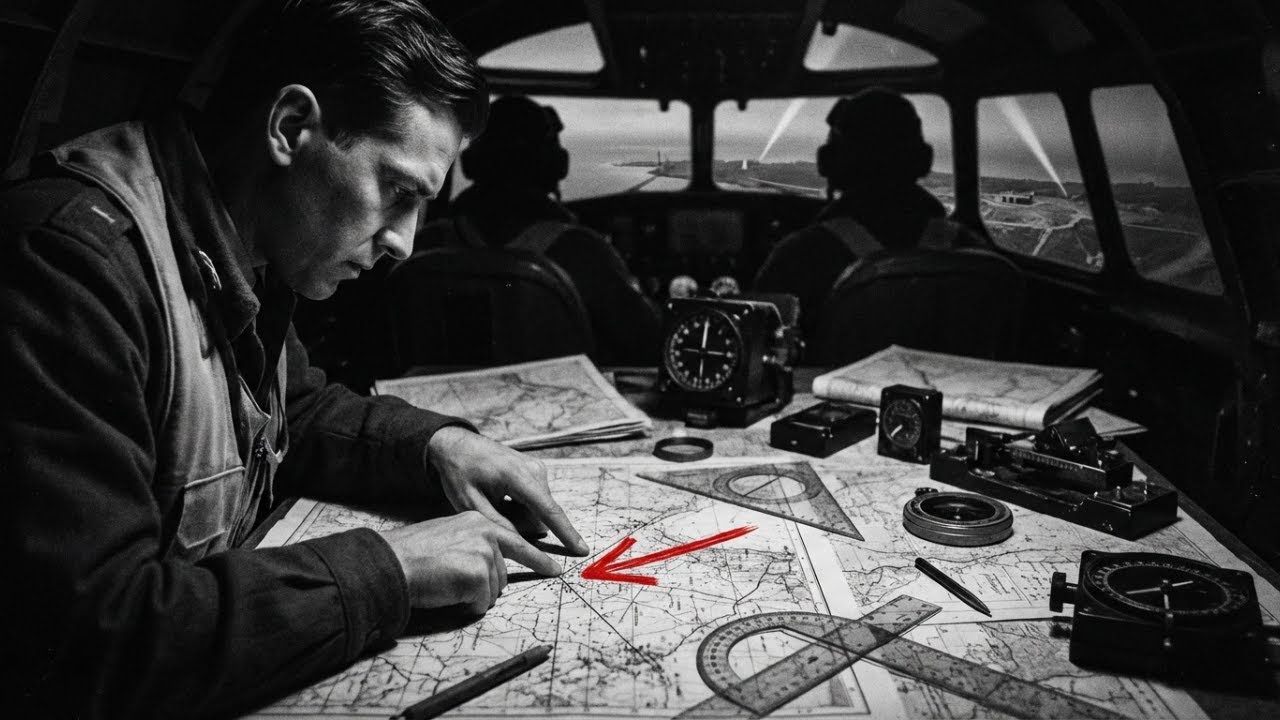
And then he sees it, his error. He’s been compensating for the wind in the wrong direction for the entire return leg. His first reaction is pure panic. They’re not approaching England. They’re flying deeper into enemy controlled airspace. They’re somewhere over the Netherlands or northern Germany. Those lights Bram is seeing aren’t British.
They’re German. His second reaction changes everything. If those are German lights and they’re this far from the known German airfields and there are multiple lights suggesting a major installation, then they’ve found something, something important. Bob, Gregory’s voice is tight as he speaks into the intercom.
Those aren’t our lights. We’re over enemy territory. I made a navigation error. We’re approximately 60 mi east of where we should be. There’s a long pause. Then Bram’s voice, surprisingly calm. Well then, sticks. Let’s take a closer look, shall we? Bram banks the bow fighter into a gentle turn, reducing altitude to 6,000 ft.
Gregory’s heart hammers against his ribs. Everything about this is wrong. They’re deep in enemy airspace with no authorization, no backup, and barely enough fuel to make it home. If they turn back immediately, if German fighters scramble, they’re dead. If German anti-aircraft batteries open fire, they’re dead.
If they run out of fuel over the North Sea, they’re dead. But Bram keeps descending 5,000 ft. 4,000 ft. The lights grow clearer. Gregory can see them now from his rearfacing position, craning his neck to look past the bow fighter’s tail. Not just lights. Dozens of lights arranged in patterns that can only mean one thing. A major airfield.
I’m seeing runway lights, Bram reports, his voice steady despite the insanity of what they’re doing. Multiple runways, large installation. There are aircraft on the ground. I count at least 20 aircraft, maybe more. Gregory fumbles with his navigation equipment, trying to get an exact position fix.
His hands are shaking worse than ever, but now it’s from adrenaline rather than cold. He takes a bearing on the lights, cross references it with his calculated position, and makes careful notes. They need to be able to find this place again. They need to be able to tell intelligence exactly where it is. There are bombers down there, Bram continues.
Hankl 111s, Junker’s 88s. This is a major bomber base, sticks. This is exactly what intelligence has been looking for. The bow fighter makes a wide orbit around the airfield at 3,500 ft. Gregory takes more bearings, more notes. He can see the layout now. Three runways arranged in a triangle pattern.
Dozens of aircraft dispersed around the perimeter, hangers, fuel storage tanks, barracks, buildings. This isn’t a forward operating base. This is a fullscale Luftvafa bomber station. And then the search lights snap on. Brilliant white beams lance into the darkness, sweeping the sky, searching for the intruder.
Anti-aircraft tracers arc upward, bright red chains of death reaching toward them. The Germans have finally realized they have an uninvited guest. Time to leave. Bram shoves the throttles forward and throws the bow fighter into a diving turn. The aircraft shutters as flack bursts explode nearby, close enough that Gregory can hear the sharp crack of detonations over the engine roar.
They’re running for their lives now, racing westward at full speed. The German search lights and tracers falling away behind them. Gregory keeps working through the escape, refining his calculations, making absolutely certain of their position because he knows what’s going to happen when they land. He’s going to have to explain how they ended up over enemy territory.
He’s going to have to admit his navigation error. He’s going to face an inquiry, possibly a court marshal, definitely the end of his flying career. But he’s also going to hand British intelligence the biggest intelligence breakthrough of the air war, and that makes everything worth it. They land at RAF Wittering at 4:23 a.m.
With their fuel tanks nearly empty, Bram taxis to their dispersal area and shuts down the engines. For a moment, both men sit in silence, processing what just happened. Then Bram’s voice comes through the intercom one last time. sticks. Whatever happens, we did the right thing. Remember that. The debriefing begins immediately.
The intelligence officer, Flight Lieutenant James Harrington, listens to their report with increasing skepticism. When Gregory admits his navigation error, Harrington’s expression hardens. When Bram describes the airfield they discovered, Harrington’s skepticism turns to outright disbelief. Let me understand this correctly, Arrington says, his voice dripping with disdain.
You flew 60 mi off course due to a navigation error. You then deliberately penetrated enemy airspace without authorization. You descended to low altitude over what you claim is a secret German airfield. And you expect me to believe this airfield exists based on a visual sighting by a crew that was hopelessly lost? Sir, I have the exact coordinates, Gregory protests, pushing his notebook across the table.
I took multiple bearings. I can show you exactly where it is. Harington barely glances at the notebook. Flight sergeant, you’ve already admitted you made a catastrophic navigation error. Why should I trust any of your calculations? For all I know, you saw a Dutch civilian airfield and mistook it for a German bomber base.
The meeting escalates. Braum, normally calm, raises his voice. I know what I saw, sir. That was a major Luftwaffa installation. There were at least 20 bombers on the ground. At night, from 3,500 ft. While being shot at, Harrington shakes his head. Your report is noted, Lieutenant, but I cannot recommend any action based on such unreliable intelligence.
You’re both grounded, pending an investigation into this unauthorized incursion into enemy airspace. The news spreads through the squadron by breakfast. Gregory faces a mixture of sympathy and ridicule from his fellow navigators. Some believe his story. Others think he’s trying to cover up his mistake with a fantastic tale.
The consensus among the senior officers is clear. Gregory screwed up and now he’s making excuses. But one person believes them. Wing commander Basil Embry, the station commander, has a reputation as a maverick. He’s flown dozens of dangerous missions himself. He understands that sometimes the best intelligence comes from accidents and mistakes.
When he reads Harrington’s dismissive report, he makes a decision that will change everything. Embry calls a meeting in his office on December 15th. Present are Bram, Gregory Harrington, Squadron leader Derek Jackson from RAF Intelligence, and Group Captain Victor Beeish, the sector commander. The room is tense from the moment they assemble.
Gentlemen, Embry begins, we have a potential intelligence breakthrough, and I will not allow it to be dismissed because it came about through unorthodox means. Harrington immediately objects. Sir, with respect, we cannot base operational decisions on unreliable sightings from a crew that was lost.
That’s exactly my point. Jackson adds, “We’ve been searching for these secret airfields for months. Every credible lead has turned into a dead end. Now we’re supposed to believe that a navigation error accidentally led to the discovery of a major German base. The odds against that are astronomical. The room erupts. Voices overlap as multiple officers argue simultaneously.
Harrington insists that authorizing a reconnaissance mission based on Gregory’s coordinates would be a waste of resources. Jackson argues that even if the airfield exists, the Germans will have moved everything after being spotted. Beemish worries about risking valuable reconnaissance aircraft on what might be a wild goose chase.
Embry lets them argue for five minutes. Then he slams his hand on the desk, silencing the room. Enough. Here’s what we’re going to do. We will send a single reconnaissance Spitfire to Gregory’s coordinates tomorrow morning. If the airfield is there, we’ve made the biggest intelligence discovery of the year.
If it’s not, we’ve wasted one reconnaissance sorty. That’s a risk I’m willing to take. He turns to Gregory. Flight sergeant, you’d better be right about this because if you’re wrong, your career is over. Gregory swallows hard. I’m right, sir. I stake my life on it. Before you navigate away, remember to subscribe to Last Words and hit that notification bell.
We’re bringing you the untold stories of military history that changed the world three times a week. Don’t miss the next one. December 16th, 1941 dawn clear and cold over eastern England. At RAF Benson, Flight Lieutenant Anthony Tony Hill climbs into his Spitfire PRMK4, a reconnaissance variant stripped of weapons and painted in distinctive pale blue camouflage. His mission is simple.
Fly to the coordinates provided by Gregory. Photograph whatever is there and return. He’s been briefed on the controversy surrounding this mission. Half the intelligence staff thinks it’s a waste of time. The other half hopes desperately that Gregory is right. Hill takes off at 8:47 a.m.
He climbs to 28,000 ft and sets course for the Dutch coast. At that altitude, he’s above the effective range of most German anti-aircraft guns. The sky is crystal clear, perfect conditions for reconnaissance photography. He reaches Gregory’s coordinates at 9:34 a.m. What he sees through his viewfinder makes him forget to breathe for a moment.
There, exactly where Gregory said it would be is a massive airfield. Hill makes three passes, his cameras clicking away, capturing every detail. He counts 43 aircraft on the ground, including bombers, fighters, and transport planes. He photographs the runways, the hangers, the fuel storage facilities, the barracks. He captures everything.
When Hill lands back at RAF Benson at 11:12 a.m., he’s grinning like a school boy. “It’s there,” he tells the intelligence officers who rush to meet him. Everything they said, it’s all there. This is the real thing. The photographs are developed within hours. They’re rushed to RAF intelligence headquarters at Bentley Priaryy.
By evening, they’re on Air Chief Marshall Douglas’s desk. The analysis confirms Hill’s initial assessment. This is Gila Ryan airfield in the Netherlands, a major Luftvafa bomber base that British intelligence had no idea existed. German records captured after the war reveal that Gilza Ryan was home to Kamfkashv 30, a bomber wing equipped with Junker’s 88s that had been conducting night raids against Britain since September 1941.
The impact of this discovery is immediate and profound. Within 24 hours, RAF Bomber Command is planning a major raid on Gila Ryan. But first, British intelligence wants to observe the base to learn its operational patterns to identify when bombers launch and return. For 3 weeks, reconnaissance aircraft photograph Gilza Rajin daily.
British signals intelligence monitors its radio traffic. The intelligence picture becomes crystal clear. This is one of the Luftvafa’s primary night bombing bases for operations against Britain. On January 7th, 1942, RAF Bomber Command strikes. 48 Bristol Blenheim bombers escorted by Spitfires attack Gilsa Ryan in broad daylight.
The raid is devastatingly successful. Bombs destroy two hangers, damage the main runway, and destroy or damage 17 German aircraft on the ground. German casualties include 23 dead and 41 wounded. More importantly, Gilzarajin is knocked out of operation for 11 days. But the real value of discovering Gilarajin extends far beyond that single raid.
British intelligence now knows what to look for. They analyze the characteristics that made Gila Rajin an effective secret base. Its location near the coast but not directly on it. Its camouflage techniques. Its dispersal patterns. They use this knowledge to identify three more secret German airfields within the next month. Lee Warden in the Netherlands, Susterberg near Utre, and Ship Hall near Amsterdam.
The statistics tell the story of how this discovery changes the air war. In the 3 months before Gilza region is discovered, German night bombers fly 347 sorties against British targets with a loss rate of only 3.7%. In the 3 months after the discovery and subsequent raids on the secret airfields, German sorties dropped to 198 and their loss rate climbs to 8.4%.
British night fighters now able to patrol near known German airfields achieve a kill ratio improvement of 127%. The human cost is equally significant. British civilian casualties from German night bombing dropped from an average of 416 per month in the September December 1941 period to 187 per month in the January March 1942 period.
that 687 British lives saved in just three months, directly attributable to the disruption of German bomber operations following the discovery of their secret airfields. German records provide the enemy perspective. Hman Klaus Hubner, a bomber pilot with Kfkos 30 based at Gills of Ryan, wrote in his diary after the January 7th raid, “The British have found us.
Our sanctuary is no longer safe. We thought we were invisible, but somehow they have pierced our veil of secrecy. Morale is suffering. The men know that we are now vulnerable. That the British bombers will return. And return they did. Between January and June 1942, RAF Bomber Command conducts 17 separate raids on the four secret airfields discovered as a result of Gregory’s navigation error.
These raids destroy or damage 127 German aircraft on the ground, kill or wound 342 German personnel, and force the Luftvafa to divert significant resources to air defense that would otherwise have been used for offensive operations. For Gregory and Bram, the discovery brings vindication, but also continued danger. They’re not grounded.
Instead, they’re assigned to continue flying night patrols, now armed with knowledge of where German bombers are operating from. On February 23rd, 1942, Bram shoots down a Hankle 111 bomber near Gilza Ryan. It’s his eighth kill. He will go on to become one of the RAF’s top knight fighter aces with 29 confirmed kills by wars end.
Gregory continues as Bram’s navigator through 1942 and into 1943. Despite his rocky start, he becomes one of the RAF’s most reliable navigators. His commanding officers note in his later evaluations, has developed into an exceptional navigator. His attention to detail and willingness to doublech checkck his work makes him a model for other navigators to emulate.
The ultimate validation comes from an unexpected source. In March 1942, Gregory receives a letter from a bomber pilot he’s never met. Flight Lieutenant Michael Stevens. Stevens writes, “I was part of the raid on Gila Ryan on January 7th. We destroyed German bombers that would have killed British civilians.
We disrupted operations that would have cost British lives.” Because of your discovery, because of your willingness to admit your mistake and report what you found, my crew and I came home safely from that mission. Because of you, we came home. If you’re enjoying this story of how one man’s mistake changed military history, take a moment to like this video and share it with someone who loves military history.
Your support helps us continue bringing these incredible stories to life. The full scope of William Gregory’s accidental discovery isn’t revealed until after the war when British intelligence declassifies its files on the secret German airfields in 1949. Historians are stunned by the cascading effects of that single navigation error on December 14th, 1941.
The discovery of Gilzerian directly led to the identification of 17 additional secret or camouflaged German airfields across occupied Europe by the end of 1942. The intelligence methodology developed from analyzing Gilzerian understanding how the Germans selected and camouflaged their secret bases became standard practice for Allied photoreonnaissance interpreters.
This methodology was later applied to identifying German VW weapon sites, submarine pens, and radar installations. The production numbers are staggering. Between January 1942 and May 1945, Allied bombers conducted 347 raids on airfields first identified using the techniques developed from the Gilzarajin discovery.
These raids destroyed or damaged 4,127 German aircraft on the ground, killed or captured 11,43 German personnel, and disrupted countless bombing missions that would have targeted Allied cities and military installations. Air Chief Marshall Sir Schultto Douglas in his postwar memoirs published in 1963 wrote, “The discovery of Gilza Ryan was a turning point in the air war over Europe.
It demonstrated that German operational security, while excellent, was not impenetrable. It gave us the tools and the confidence to systematically hunt down and neutralize the Luftvafa’s secret infrastructure. And it all came about because a young navigator made a mistake and had the courage to report what he found.
The modern legacy of Gregory’s discovery extends into current military doctrine. The principle that intelligence breakthroughs often come from unexpected sources, including mistakes and accidents, is now taught at military intelligence schools worldwide. The US Air Force Intelligence School at Goodfellow Air Force Base includes the Gilzeruan Discovery in its curriculum as a case study in the importance of reporting all observations, even those resulting from errors.
As for Gregory himself, he refused all attempts to make him famous. After the war, he returned to Nottingham and resumed working in retail, managing a grocery store until his retirement in 1979. He rarely spoke about his wartime service when reporters occasionally tracked him down for interviews. He deflected credit to Bram, to the reconnaissance pilots who confirmed his discovery to the bomber crews who struck the German airfields.
In 1988, at age 70, Gregory gave his only extensive interview to an RAF historian. His final words on the subject capture the humility that defined his character. I made a mistake, a potentially fatal mistake. But Bob Bram had the sense to investigate what we found. And Wing Commander Embry had the courage to believe us.
I was just the navigator who got the math wrong. They were the real heroes. William Gregory died in 1994 at age 76. His obituary in the Nottingham Post mentioned his wartime service in a single sentence. But in the archives of RAF Intelligence, in the history books that chronicle the air war over Europe, his name appears alongside the greatest intelligence breakthroughs of World War II.
All because one cold December night he subtracted when he should have added and accidentally changed the course of history.
News

Sensationell! Krall nimmt kein Blatt vor dem Mund!
Dr. Markus Krall nimmt kein Blatt vor dem Mund. Die heutige CDU wird von vielen Linksradikalen geführt….

Jeder geigt ihr die Meinung & sie kommt nicht darauf klar
die Migration kostet Deutschland jährlich 50 Milliarden Euro Steuergelder hart erarbeitetes Steuergeld und da ist es…

Er hat sie hintergangen! Polizistin & Bund der Steuerzahler gar nicht zufrieden
Mario Vogt hat nicht etwa Stellen abgebaut, wie groß angekündigt. Im Gegenteil, er hat noch mehr Leute…

Lanz: “Kinder fassen zum ersten Mal einen Stift an!” Reine Fassungslosigkeit! Hüther schlägt Alarm
die Grundschule verlassen und immer noch nicht lesen und schreiben können und viel zu dick sind und…

Wir sind ihnen egal
die Autorin undistin Birgit Kelle ist ein geresehener G bei dem Nachrichtenportal sie ist über die …

Hier wird mit zweierlei Maß gemessen – Zum Abschuss freigegeben – Antje Hermenau
die Gewalt an Politikern nimmt stetig zu doch wenn es ein Politiker von der AFD ist ist…
End of content
No more pages to load